


Supreme Court Hearing on Sabarimala Case
Syllabus: GS1/ Society/ Culture, GS2/ Polity and Governance
Context
- A nine-judge bench of the Supreme Court of India has begun hearings on petitions concerning women’s entry into religious places, including the Sabarimala Temple.
Background
- In 2018, a Constitution Bench (4:1 majority) allowed entry of women of menstruating age into the temple, declaring the restriction unconstitutional.
- Due to widespread protests, in 2019, the matter was referred to a larger bench. The Court started reviewing this, along with other issues of women’s entry into religious spaces.
- Significance: The issue reflects tension between Fundamental Rights on equality/non-discrimination (Articles 14, 15, 17) and Religious Freedom (Articles 25, 26).
- It also raises questions on Judicial activism vs restraint and Secularism in India (principled distance model).
About Sabarimala Temple
- Location and Deity: The Sabarimala Temple is located in the Pathanamthitta district of Kerala on the banks of the sacred Pamba River (also known as Pampa), within the Periyar Tiger Reserve in the Western Ghats.
- It is dedicated to Lord Ayyappa, also known as Dharmashasta.
- The temple is situated on a hilltop at an elevation of about 1,260 metres.
- Religious Significance: It is one of the largest annual pilgrimage centres in the world. Devotees undertake a rigorous 41-day ‘Vratham’ (penance) before visiting.
- The temple symbolises celibacy (Naishtika Brahmacharya) of Lord Ayyappa.
Source: TH
Govt. Plans ₹2.5 Lakh Crore Credit Guarantee Scheme
Syllabus: GS2/Governance
Context
- The government is considering a ₹2.5 lakh crore credit guarantee scheme to support businesses, especially MSMEs impacted by the West Asia crisis.
About
- The scheme will be an expansion of the Emergency Credit Line Guarantee Scheme (ECGLS) framework.
- The scheme is expected to be valid for four years and about Rs 100 crores cover would be given to different sectors and sub-sectors.
- The guarantee on bank loans would be provided by the National Credit Guarantee Trustee Company (NCGTC), a wholly-owned subsidiary of the government.
- Under the scheme, a credit guarantee of about 90% on loans of up to ₹100 crore would be provided to lenders in case of default by borrowers.
Emergency Credit Line Guarantee Scheme (ECLGS)
- It was launched in 2020 as part of the Aatmanirbhar Bharat Abhiyaan to support eligible MSMEs and other eligible business enterprises due to the disruption caused by the COVID-19 pandemic.
- ECLGS covered almost all the sectors of the economy, and a 100% guarantee was provided to Member Lending Institutions (MLIs).
- The structure of the scheme permitted easy access to credit, the interest rate was also capped with a view to lowering the cost of credit and loans were sanctioned without any processing charges.
- The Scheme continued till March 31, 2023.
Source: TH
United Nations Security Council (UNSC)
Syllabus: GS2/ Important International Institutions
In News
- Russia and China vetoed a UN Security Council resolution aimed at reopening the Strait of Hormuz.
About the United Nations Security Council (UNSC)
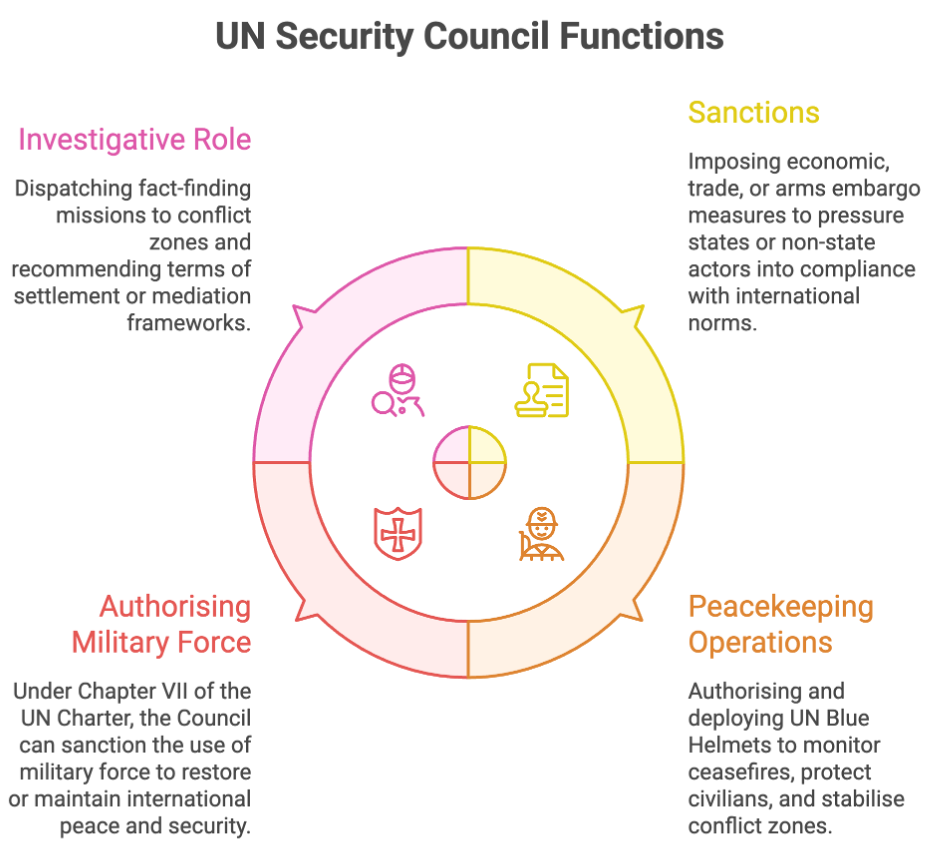
- Brief: The UNSC is one of the six principal organs of the United Nations, carrying the primary responsibility for maintaining international peace and security. It is the only UN body empowered to issue legally binding resolutions that all UN member states are obligated to comply with under international law.
- Structure and Composition: The Council has 15 members divided into two categories:
- Permanent Members (P5) with Veto Power: China, France, Russia, the United Kingdom, and the United States. A single veto from any P5 member is sufficient to block any substantive resolution, regardless of how many other members support it.
- Non-Permanent Members (10 seats): Elected by the UN General Assembly for two-year terms, distributed geographically.
- Headquarters: New York, USA
- How Does It Work?
- Voting: Each member holds one vote. A resolution requires a minimum of 9 affirmative votes with no P5 veto to pass.
- Presidency: Rotates monthly among the 15 members in English alphabetical order.
- Binding Nature: Under Article 25 of the UN Charter, all member states agree to accept and implement UNSC decisions.
Source: TH
Amendments to Mineral Concession Rules
Syllabus: GS3/ Economy
Context
- The Ministry of Mines has notified the Minerals (Other than Atomic and Hydro Carbons Energy Minerals)Concession (Second Amendment) Rules, 2026 to operationalise recent reforms in the mining sector.
- The new rules are based on changes made in the Mines and Minerals (Development and Regulation) Act, 1957 (MMDR Act) through the 2025 amendment.
Key Features of the Amendment Rules
- Inclusion of Contiguous Area: Mining Lease (ML) or Composite Licence (CL) holders of deep-seated minerals are allowed a one-time extension to include adjoining (contiguous) areas.
- The extension is capped at 10% of existing area for ML and 30% of existing area for CL. This aims to ensure optimal extraction of mineral deposits that may otherwise remain unviable.
- Provisions for Minor and Major Minerals: The rules provide a clear method to deal with cases where major minerals are found in old minor mineral leases granted before 2025.
- Minor minerals specifically include building stones, gravel, ordinary clay, and ordinary sand.
- Major Minerals cover all minerals other than minor minerals; examples include Coal, Iron Ore, Zinc, Limestone, Bauxite, and Gold.
- Minor minerals are regulated by State Governments; major minerals fall under the purview of the Union Government.
Source: PIB
Mission MITRA
Syllabus: GS3/ Science & Technology; Space Technology
In News
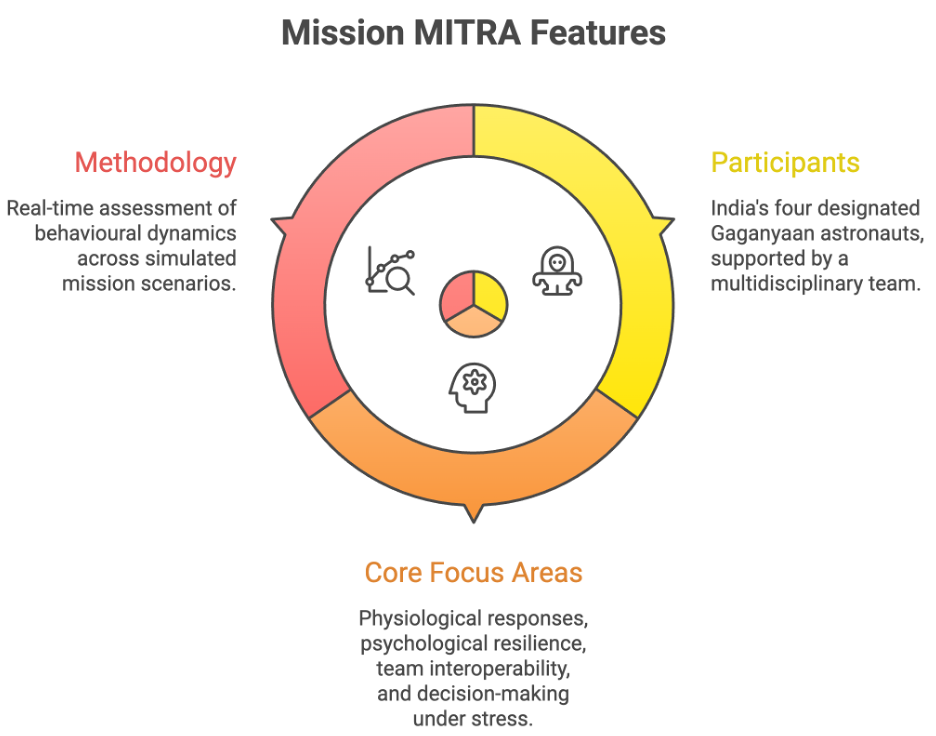
- The Indian Space Research Organisation (ISRO), in collaboration with the IAF-Institute of Aerospace Medicine, has launched Mission MITRA in Leh, Ladakh.
What is Mission MITRA?
- About: MITRA stands for Mapping of Interoperable Traits and Response Assessment. It is a structured scientific study designed to simulate and evaluate the human dimensions of long-duration spaceflight missions in a controlled yet extreme terrestrial environment.
- Nature: First-of-its-kind team behavioural and physiological study in India’s human spaceflight programme.
Source: TH
Lunar Ring Project
Syllabus: GS3/Science and Tech
Context
- Japan’s Shimizu Corporation has proposed an ambitious mega-project called the “Lunar Ring”—a massive belt of solar power plants along the Moon’s equator.
About the Project
- The project envisions a solar panel belt stretching 11,000 km and about 400 km wide around the Moon.
- The structure would be constructed by robots using lunar regolith (soil), reducing the need to transport materials from Earth.
- It would continuously capture solar energy and beam it to Earth via microwaves, enabled by the Moon’s near-constant sunlight and lack of atmosphere.
- It is a variant of space-based solar power (SBSP) that involves capturing solar energy in space using satellites with photovoltaic cells or mirrors and transmitting it wirelessly via microwaves or lasers to Earth-based receivers.
- Key Challenges: High cost of transporting infrastructure, technological constraints, energy dissipation & operational risks due to space debris.
Source: TH
Government Notifies Two Institutions as Repositories
Syllabus: GS2/Governance
Context
- The National Biodiversity Authority, in consultation with the Ministry of Environment, Forest and Climate Change, has enabled the notification of two institutions as designated repositories under the Biological Diversity Act, 2002.
About
- The two institutions are Referral Centre Bhavasagara at Centre for Marine Living Resources and Ecology (CMLRE), Kochi, and MACS Collection of Microorganisms and National Fungal Culture Collection at Agharkar Research Institute, Pune.
- The BDA 2002 empowers the Central Government to designate institutions as repositories for different categories of biological resources.
- These repositories are entrusted with maintaining biological materials in safe custody, and any person discovering a new taxon is required to notify the designated repository.
Additional Information
National Network of Repositories
- So far, 18 institutions have been designated as national repositories under Section 39 of the Act.
- With the addition of these two institutions, the national network of repositories is further strengthened, enhancing the conservation and systematic documentation of biological resources.
- This will ensure that biological materials are preserved under appropriate scientific conditions and made accessible for research and innovation.
National Biodiversity Authority (NBA)
- It is a statutory authority set up under India’s Biological Diversity Act (2002).
- It came into existence in 2003, with its headquarters in Chennai.
- It provides facilitative, regulatory, and advisory functions to the Government of India on issues of conservation, sustainable use, and fair and equitable sharing of benefits arising from the country’s biological resources.
- Under the Biodiversity Act, 2002 and Biodiversity Rules, 2004, the following two other entities have been established to complement the NBA:
- State Biodiversity Boards (SBB) at the State level, and
- Biodiversity Management Committees (BMC) at the local village level.
Source: PIB
Previous article
Sundarbans Losing Ability to Recover
Next article
Elephanta Caves
